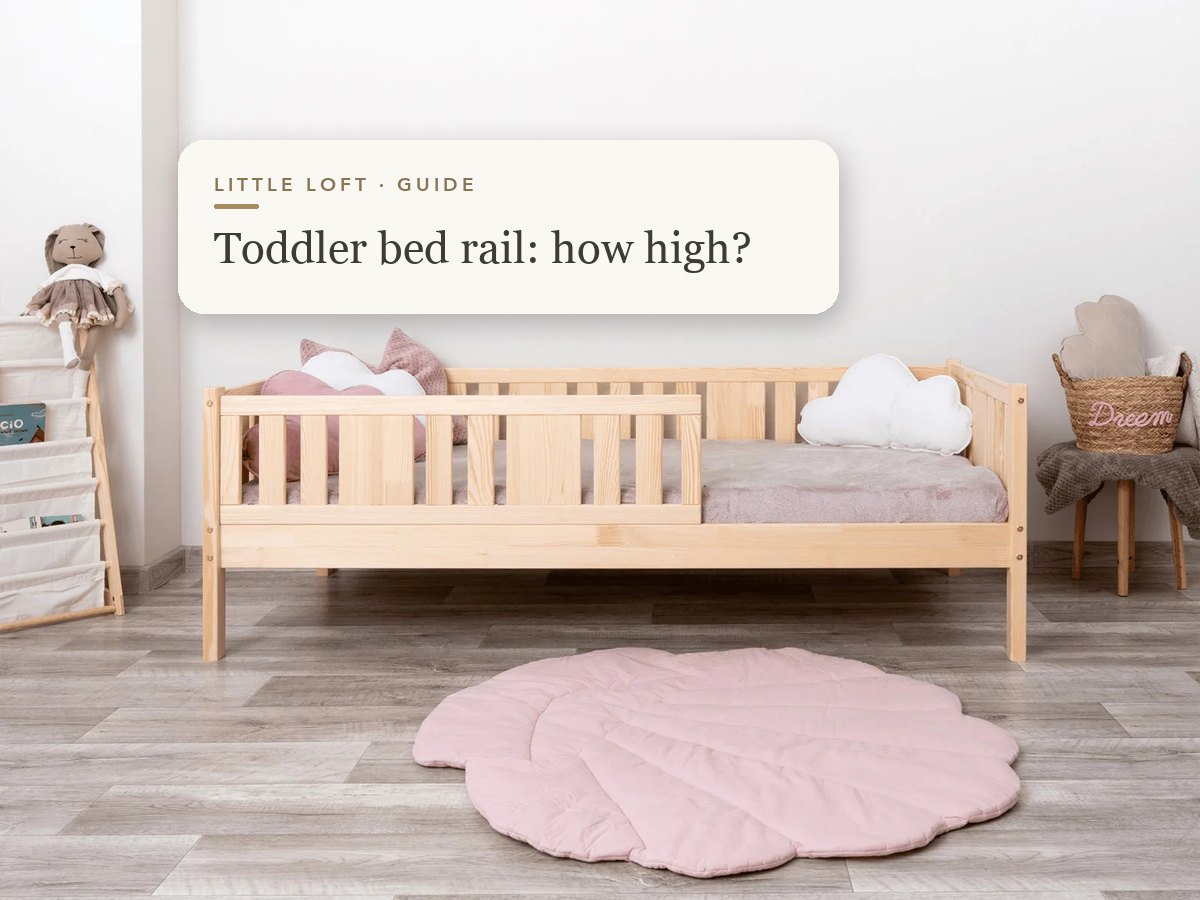
Bed Rail for Toddler Beds: How High, How Long and Until What Age?
A bed rail for toddler beds: how high it should stand above the mattress, what length is enough and when your child can sleep without one. With tables and a checklist.
Looking for a bed rail for toddler beds and wondering how high, how long and until what age? In short: after the cot, almost every child needs a rail on the open side of the bed, usually until the age of 3 to 5. It should stand clearly above the mattress and leave a way in and out. Bunk beds and high sleepers follow a fixed rule: at least 16 cm above the mattress on every side – and the top bunk only from the age of six.
In short
- When: from the move out of the cot, usually at 1½ to 2.
- How high: what counts is how much rail is left above the mattress.
- How long: a little over half the bed, at the head end. The way in stays clear.
- Until when: until your child has slept calmly for several weeks, often between 3 and 5.
- Top bunk: the guard rail always stays on – and nobody under six sleeps up there.
Do toddlers need bed rails?
In a cot, your child bumps into the bars at night and rolls back. In the first big bed that boundary is gone, and toddlers still move a lot in their sleep without sensing the edge. A toddler bed rail – some call it a bed guard – replaces the bars on the side where there is a drop.
How much it matters depends mostly on the height of the bed:
| Bed | Lying height | Bed rail |
|---|---|---|
| Floor bed | on the floor | helps, not essential |
| Bed on legs | approx. 20–35 cm | useful until 3–5 |
| “Big” bed | 40 cm and more | needed for toddlers |
| Top bunk | over 1 m | always, on every side |
On a bed that stands straight on the floor, a fall is just a roll onto the rug. Even so, many children sleep more calmly with a rail: they feel a boundary, as they did in the cot. Which bed suits which age is covered in our guide to a bed for a 2 year old.
How high should a bed rail be?
For ordinary, low children’s beds no figure is laid down. One measurement counts: how much of the rail stands above the mattress. A rail that is 30 cm high on paper loses height with every thicker mattress.
An example: if the rail stands 30 cm above the slats and the mattress is 12 cm deep, 18 cm of protection is left. With a 20 cm mattress it is only 10 cm – and a sleeping child rolls straight over that.
Bunk beds and high sleepers are different. The European standard EN 747 requires the guard rail to stand clearly above the mattress – at least 16 cm, on every side. That is why these beds always come with a maximum mattress thickness.
Mattress first, then the rail
Measure from the top of the mattress to the top of the rail. For the top bunk of our KOSMO beds, for example, we recommend a mattress 8–12 cm deep. The figure for your model is on its product page.
How long should it be: half length, full length or all round?
The most common mistake happens here: parents pick the longest rail they can find. Then the child cannot get out of bed alone – and climbs over it. That is the very fall a bed rail is there to prevent.
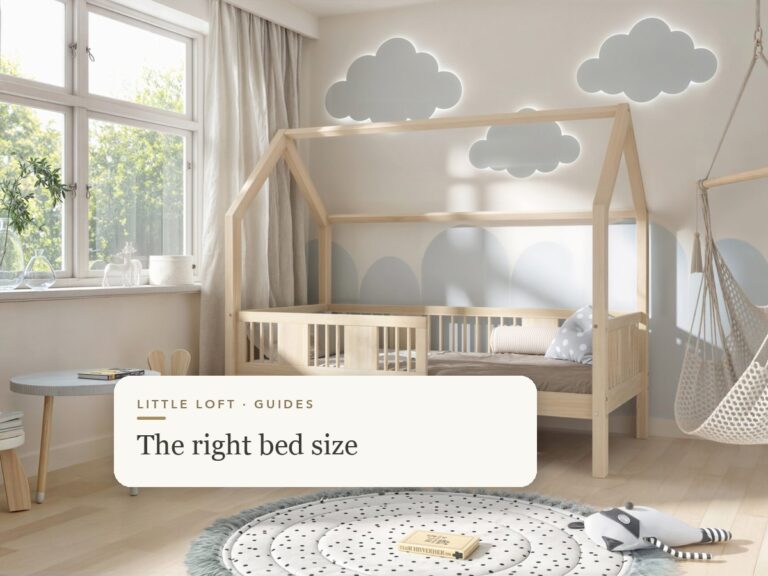
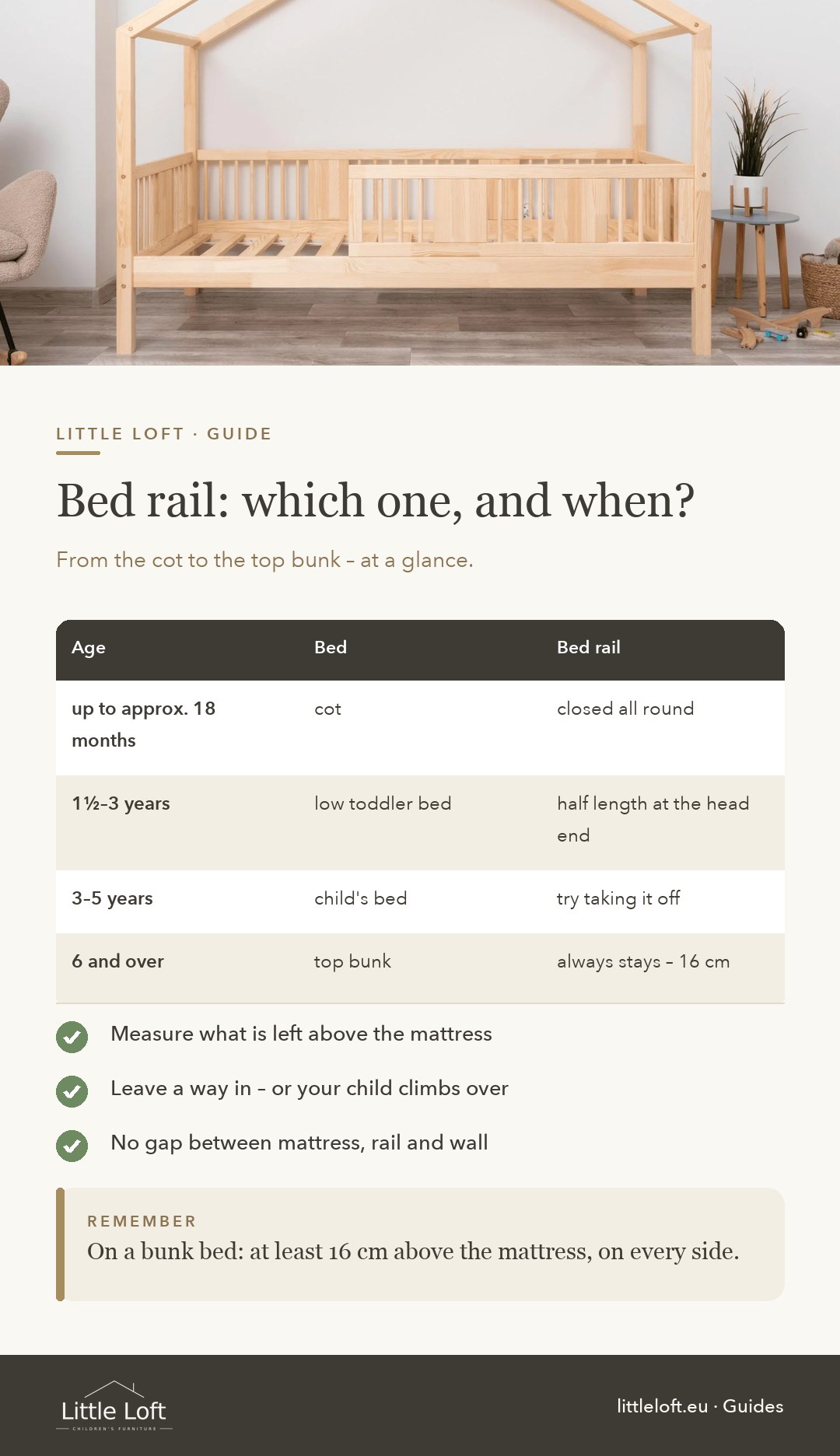
- A little over half the length, at the head end. The upper body is protected and the foot end stays open. This suits most children from about 2. On our beds this safety rail is 110 cm long – the same on every bed size.
- Two short sections with the way in between. Handy for children who wander round the whole bed at night.
- All round, with a gate. An enclosed sleeping place, like a cot at floor level – for the youngest, who should not get up on their own yet.
If one long side stands against the wall, a rail on the open side is enough – as long as no gap is left between mattress and wall. A bed standing free in the room needs a rail on both sides.
Built-in or add-on bed rail: which is better?
There are two kinds, and they differ more than you might think.
The rail that is part of the bed. It is bolted to the frame and matched to the sleeping surface, so no gap opens up between rail and mattress. On our pine wood house beds such as the LUMINA Children’s Bed it is included, fits left or right and can be taken off later. On plainer models such as the ELLA Children’s Bed you add it as an option.
The add-on bed rail. It slides under the mattress or clamps to the frame and fits almost any bed – the spare bed at Granny’s included. In return, you have to check the fit yourself:
- Read the age range. Most makers state 18 months to 5 years. The UK’s Child Accident Prevention Trust gives the same range and names the standard to look for, BS 7972. These rails are not meant for babies.
- Leave no gap at the mattress. The rail must sit tight against it; a child can get trapped in a gap.
- Keep space at head and foot. Follow the figure in the instructions – the Trust’s advice is 250 mm on each side.
- Check it whenever you make the bed. A clamp-on rail creeps out of place over time.
For the child’s own room the built-in version is the calmer choice: it is put on once and stays put.
How long do toddlers need bed rails?
There is no fixed age. Most children stop needing a rail between 3 and 5; for children under 3 we always recommend one. These signs tell you more than a birthday:
- Your child mostly wakes up where they fell asleep.
- They have not rolled against the rail for several weeks.
- They get in and out confidently alone – even half asleep, on the way to the toilet.
- They ask for it themselves: “I’m big now.”
| Age | What usually fits | Why |
|---|---|---|
| up to approx. 18 months | cot | needs sides all round |
| 1½–3 years | rail on the bed | still rolls a lot |
| 3–5 years | trial without | sleep gets calmer |
| 6 and over | top bunk | guard rail stays on |
Take the rail off for the daytime nap or at the weekend first, and lay a soft rug or blanket in front of the bed for the first few nights. If your child does fall out, put the rail back and try again in two or three months. That is not a step backwards.
Is a floor bed enough instead of a high rail?
For many families it is the simplest answer: a child who cannot fall far does not need a high barrier.
On the NIKO Mini Children’s Bed the frame sits directly on the floor; the safety rail is still included and can be removed. Later, a set of legs turns it into an ordinary child’s bed. All beds of this kind are under Cot Beds.
For the very youngest there is a second design: on the TEO Montessori Bed, 55 cm rails with slats 5 cm apart run right round the bed, and the entrance is closed by a gate that the parents open and close. It is a protected sleeping space – like a cot, only at floor level. More in our guide to a floor bed for a 1 year old.
What about bunk beds and high sleepers?
Here the guard rail is part of the structure – and it is never taken off. Three things to check:
- EN 747. The European standard for bunk beds and high beds: at least 16 cm of guard rail above the mattress, on every side.
- Maximum mattress thickness. It is marked on the bed or given in the instructions. Keep to it – Ireland’s health service, the HSE, lists a child slipping between guard rail and mattress among the dangers of bunk beds.
- Top bunk from six. The HSE’s advice is plain: no child should sleep on the top bunk until they are at least 6 years old, and bunk beds are not for playing on.
On our bunk beds and high sleepers the guard rail on top is always included. On the KOSMO Bunk Bed it is 30 cm high; the lower bed lies just 22 cm above the floor and has a short rail of its own – the younger sibling sleeps below, the older one on top.
Which mistakes are most common?
- Too thick a mattress. It eats up the height of the rail. Check the maximum mattress height first.
- A rail along the whole length. With no way in, the child climbs over – and falls from higher up.
- A gap at the wall. A child can slide into it. Push the bed right up, or protect both sides.
- Pillows instead of a rail. A wall of pillows has shifted within the hour. It is no substitute for a fixed rail.
- Taking it off too soon. Two quiet nights prove nothing. Wait a few weeks.
- An add-on rail for a baby. Under 18 months a child belongs in a cot, not in a big bed with a clamp-on rail.
The bottom line: as high as needed, as open as possible
A good bed rail keeps your child in bed at night and lets them get up alone in the morning. Look for three things: enough height above the mattress, a clear way in and a firm fixing to the bed. Take it off when your child no longer needs it – not because a birthday has come round.
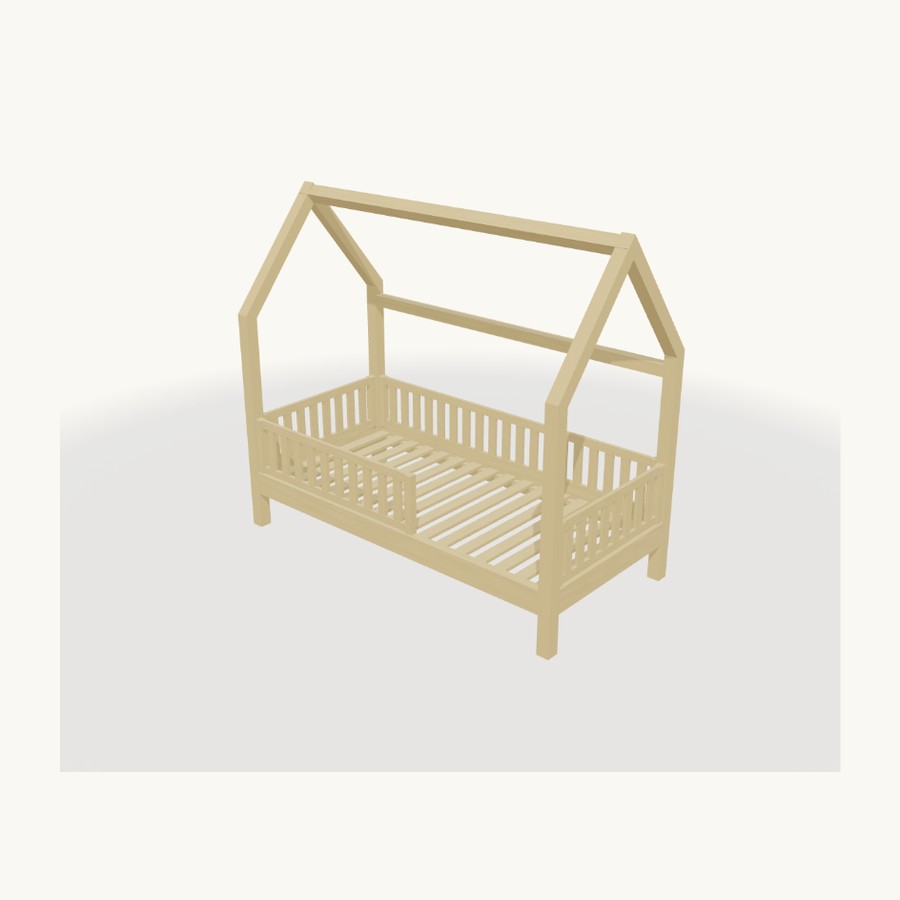
In the 3D configurator you choose the model, size, colour, safety rail and legs and see the bed from every side before you order.
Frequently asked questions about toddler bed rails
How high should a bed rail be above the mattress?
On bunk beds and high sleepers the European standard EN 747 requires the guard rail to stand at least 16 cm above the mattress on every side. For low children’s beds no figure is laid down; the rail simply has to stand clearly above the mattress. Always check the maximum mattress height the maker gives for the bed.
How long do toddlers need bed rails?
Most children sleep without a bed rail between the ages of 3 and 5; there is no fixed limit. Good signs: your child wakes up where they fell asleep, has not rolled to the edge for weeks and gets in and out safely alone. Try it at nap time first, with a rug in front of the bed.
Is a bed rail on one side enough if the bed is against the wall?
Yes. If one long side of the bed stands against the wall, a rail on the open side is enough. Push the bed right up to the wall so that no gap is left for your child to slip into. A bed that stands free in the room needs a rail on both long sides.
Does a floor bed need a bed rail?
Not necessarily. If the frame stands straight on the floor, your child cannot fall far – at most they roll onto the rug. Many children still sleep more calmly with a short rail, because they feel a boundary as in the cot. It also makes sense on a hard or cold floor.
How long should a toddler bed rail be?
A little over half the length of the bed, at the head end, is enough for most children. The upper body is protected and the foot end stays open as the way in. A rail along the whole length is not a good idea: the child climbs over it and falls from higher up.
What age can a child sleep on the top bunk?
From six. Ireland’s HSE advises not to let a child sleep on the top bunk until they are at least 6 years old, and the same goes for a high sleeper. The guard rail on top always stays on and must stand at least 16 cm above the mattress on every side – mind the maximum mattress thickness.