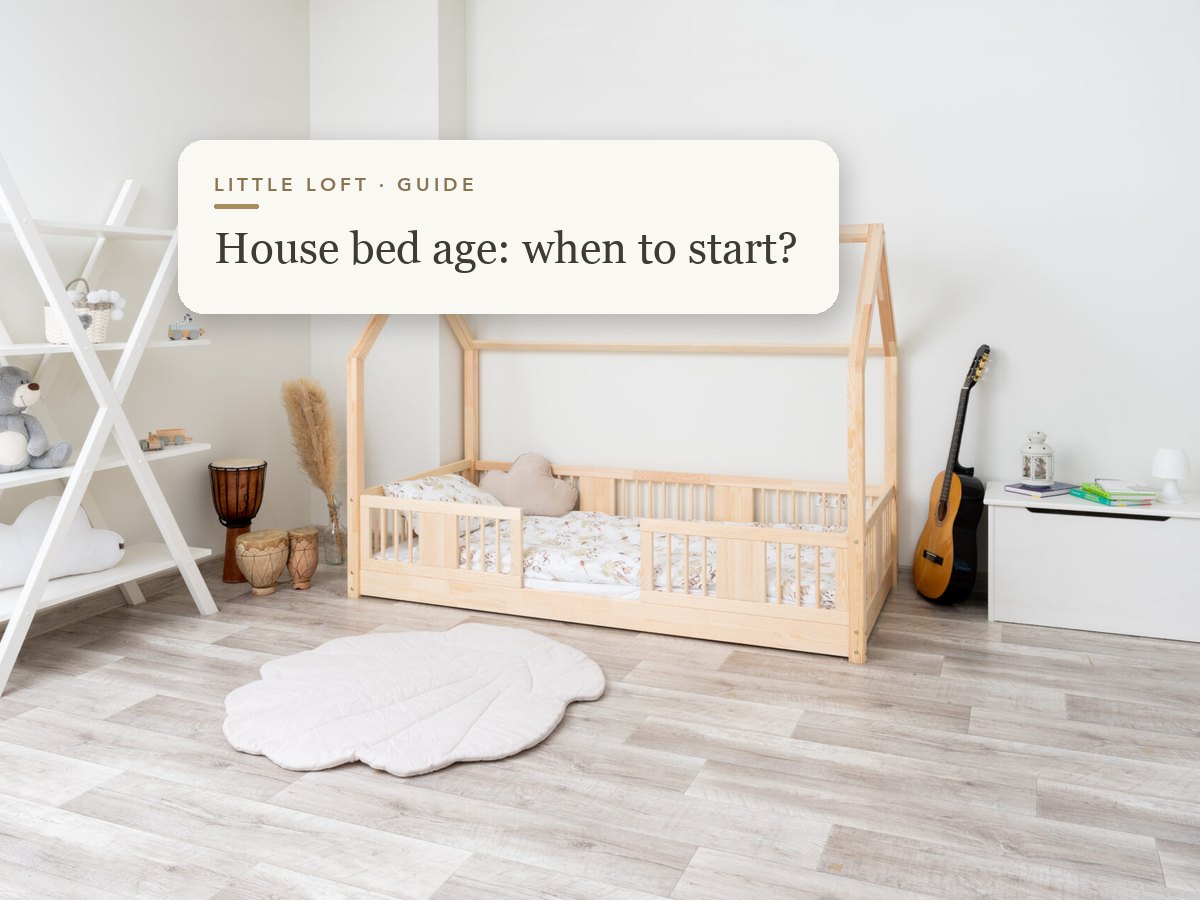
House Bed Age Guide: When to Start, Pros and Cons
House bed age guide: when a child can start, how long the bed lasts and what the real downsides are. With an age table, measurements and a checklist.
House bed age is the first thing parents ask about: when can a child start, and when is the bed outgrown? In brief, a low house bed works once your child leaves the cot, typically between 1½ and 2. Add a bed rail, pick 90×200, and it can stay until around 12. There are honest downsides too: the roof wants ceiling height, making the bed is slower, and a ten-year-old may decide the little house is for small kids.
The essentials
- Starting age: when your child begins climbing out of the cot – typically 1½ to 2.
- For toddlers: a house bed at floor level with a bed rail. Legs can follow later.
- Upper age: about 12 in 90×200. An 80×160 is too short at around 5.
- Main advantage: a sheltered spot that belongs to them, which eases the switch to a big bed.
- Main drawback: height. A house bed often will not go under a sloped ceiling.
House bed age: when can a child start?
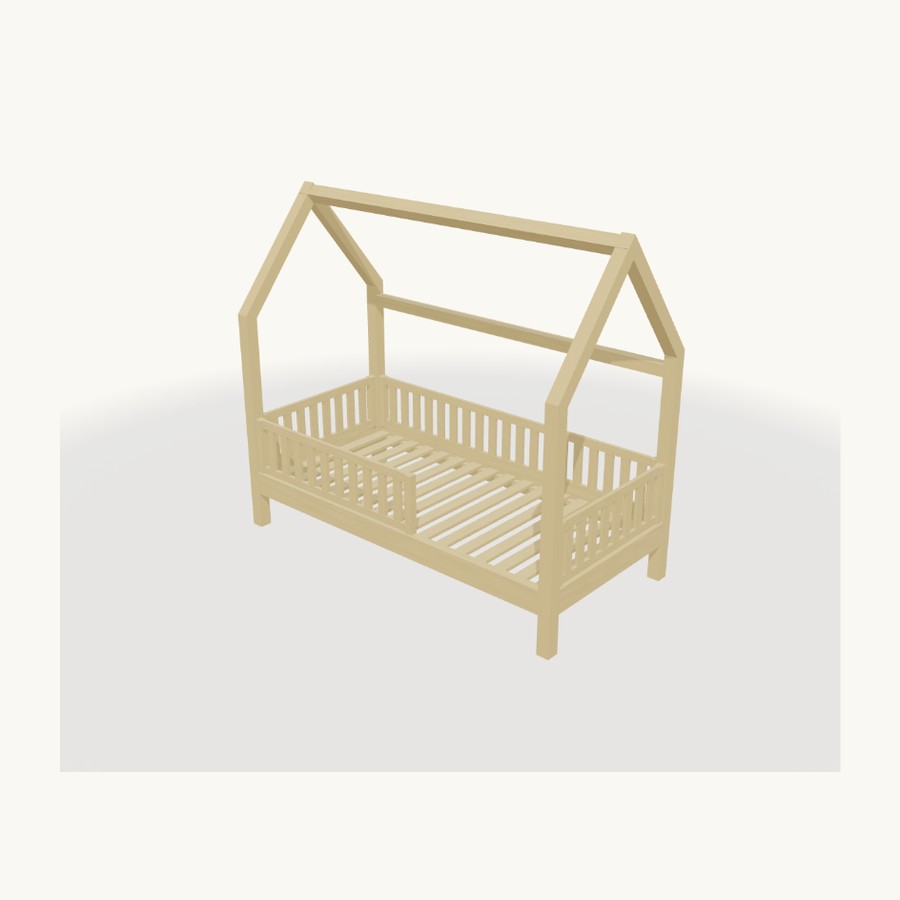
A house bed is simply a child’s bed with a timber roof frame above it. The roof has nothing to do with age. Two things do: how far the mattress is from the floor, and whether there is a bed rail.
The time to switch is when your child starts trying to get over the cot side. The HSE notes that most young children stay in a cot until they are between 2 and 3, and advises parents to change to a low bed if a child learns to climb out of the cot or grows too big for it. A low house bed is that low bed – with more space.
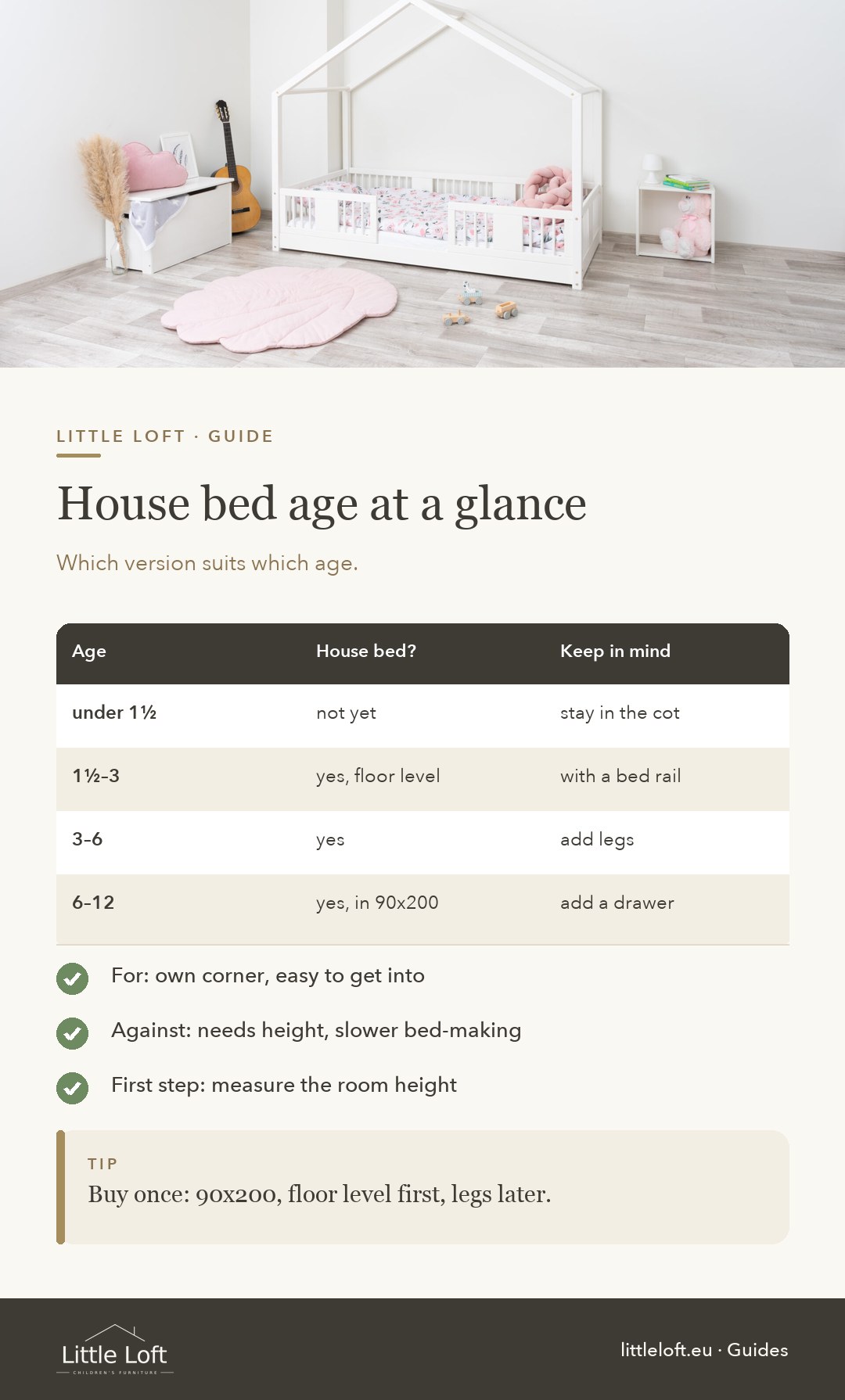
| Age | House bed? | Keep in mind |
|---|---|---|
| under 1½ | not yet | cot, or floor bed with gate |
| 1½–3 | yes, at floor level | bed rail, low mattress |
| 3–6 | yes | on legs, rail as needed |
| 6–12 | yes, in 90×200 | no rail, with drawer |
A child younger than 1½ who still needs an enclosed sleeping space is better served by a floor bed with rails on every side. The TEO Montessori bed has a gate across the entrance, and parents open and close it. Our guide to a floor bed for a 1 year old goes into detail.
One case is different: a house bed that is a bunk bed or a high sleeper, with the child sleeping up top. The HSE says no child should sleep on the top bunk until they are at least 6.
How long will a child fit in a house bed?
Size decides nearly everything. These are the ages we recommend for each size:
| Size | Suggested age | Best as |
|---|---|---|
| 80×160 | 1½ to 5 | a first bed |
| 90×180 | 2 to 8 | for a box room |
| 90×200 | 2 to 12 | the long-term bed |
Buying only once? Then 90×200 is the one, and it is the size chosen most often in our shop. A two-year-old will seem lost in it to begin with; the bed rail and some cushions at the foot fix that. Our guide to kids’ bed sizes by age lists the measurements for each age.
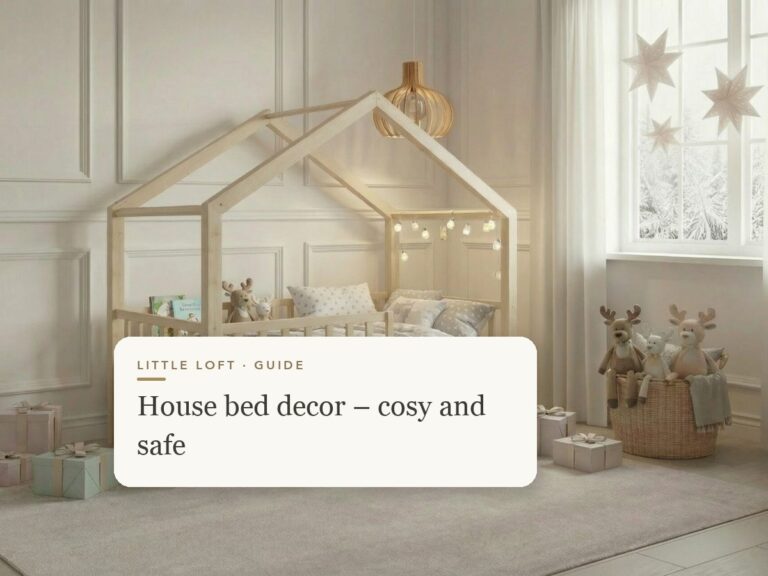
Then there is taste. Around nine or ten, some children feel the house shape is too young for them. Others keep it well into their teens and restyle the roof each year with string lights or a curtain – see our house bed decorating ideas.
Why choose a house bed? Five advantages
- Their own corner. With a roof overhead, the bed feels like a hideout. Plenty of children go to “their house” more willingly than to a plain bed, and leaving the cot is less of a wrench.
- Easy to get into. The frame of a floor-level house bed rests directly on the floor, so your child gets in and out without help.
- A bed by night, a playhouse by day. It doubles as a reading nook, a shop or a fort – useful where there is no room for extra play furniture.
- It adapts. Take the rail off, put legs under it, add a drawer: the bed changes with your child.
- Strong enough for a grown-up. The product page gives a load of about 190 kg for our pine wood house beds, so you can lie alongside for the bedtime story.
What are the downsides of a house bed?
Not every room suits one. Seven things to know beforehand:
- Height. A house bed stands far taller than an ordinary child’s bed. The dimension drawing for our ASTRIA in 90×200 shows 168 cm to the ridge. That can be too much in an attic room or beneath a low window.
- Visual bulk. The roof frame fills the eye, although the floor area is barely larger than a standard bed’s.
- Slower bed-making. There is a post at each corner, and the fitted sheet has to be worked around them – kneeling, if the bed is at floor level.
- No climbing. Children like to swing from the ridge, and the frame is not designed for it. Set the rule early.
- A few bumps at first. Some children knock their head on a bar in the first days. They learn quickly.
- Dusting. The roof bars collect dust, more so with fabric or lights on them.
- A definite look. A plain bed moves on into a teenager’s room. A house bed remains a child’s bed.
It pays off less in very low rooms, for a child of eight or so who is getting a new bed, and when you plan to reuse the bed for guests.
Measure first
Check the room height at the exact spot planned for the bed. With a sloped ceiling, measure where the ridge will sit rather than at the wall. Each product page has a dimension drawing with the exact figures for every size.
How much room does a house bed take up?
Not as much as it seems. The lying surface equals the mattress, and the frame adds a little: ASTRIA in 90×200 has a footprint of roughly 210 x 97 cm on its dimension drawing.
Plan for these as well:
- 60 cm of free floor on the entry side, for getting up easily.
- Space for the drawer if you want one – it comes out by its whole depth.
- A gap to radiators and windows, above all when fabric hangs on the roof.
With one long side against a wall, a single bed rail is enough. On our house beds it goes on the left or the right.
Floor-level house bed or one on legs?
It is one bed in two heights.
At floor level (Mini): the frame sits on the floor – ideal from 1½ to 3. Should your child roll out, it is a matter of centimetres. See the LUMINA Mini children’s bed.
On 20 cm legs: it looks like a grown-up bed and leaves space below for a drawer. Suitable from around 3. See the LUMINA children’s bed.
The choice is not final. Legs can go under a Mini bed later, in sizes up to 120×200. Only 140×200 exists at floor level alone.
Does a house bed need a bed rail?
Under the age of 3, we always advise one. Our house beds come with a rail, in one of two layouts:
- a single 110 cm rail – entry at the foot end;
- two short rails – entry in the middle.
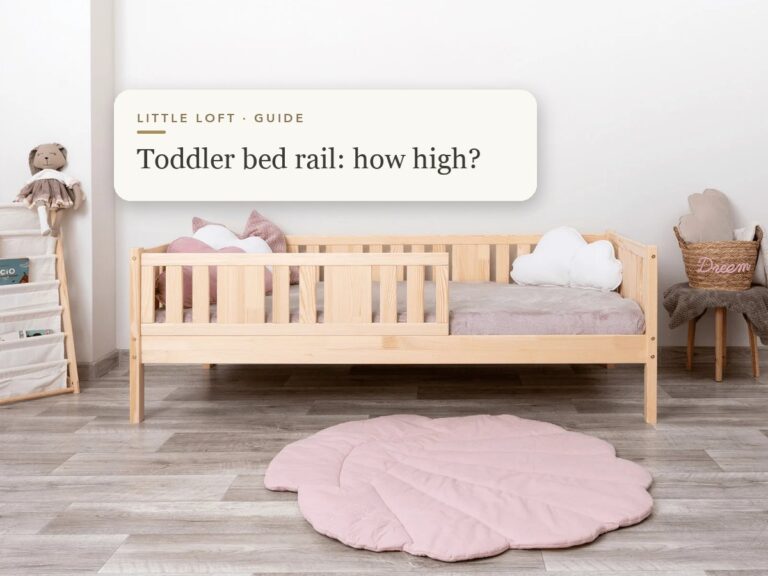
It comes off again when no longer needed. Timing and the right height are covered in our bed rail guide for toddlers.
Is a drawer under the house bed a good idea?
It is, in a small room or when visitors sleep over. The drawer rolls on castors beneath a house bed on legs. There are three kinds: one for storage, a pair of smaller ones, or one with a guest bed function.
The ASTRIA children’s bed with drawer is an example. For the second mattress, see our guide to a trundle bed for kids.
Below the age of 3, the floor-level version with no drawer is mostly the wiser pick. The drawer can come along with the legs.
Checklist: will a house bed suit your family?
- Your child is climbing out of the cot or has reached 1½.
- You have measured – not estimated – the ceiling height at the bed’s spot.
- Roughly 60 cm of floor stays free at the entry side.
- The size is settled: 90×200 for the long run, something smaller for a box room.
- There is a bed rail, and it is removable.
- You have chosen between floor level now and legs from the start.
- It is real wood, not foil over chipboard. Ours are pine wood (FSC).
Five ticks or more, and a house bed is a sound choice. Still undecided on model or size? The Bed Advisor narrows it down in a few questions.
Summary: from 1½–2, and for more years than expected
A house bed makes sense when the cot has become too small or no longer safe. Low to the floor and with a rail, it gives a toddler a gentle start in a big bed. On legs and in 90×200, it lasts through the primary school years.
Height, bed-making and style are genuine drawbacks, but you can check all three in advance. The 3D configurator lets you pick the model, size, colour, safety rail and legs and turn the bed around on screen before ordering.
House bed questions parents ask
What is the right house bed age to start?
Most children can move into a low house bed when they leave the cot, typically between 1½ and 2. The mattress should be near the floor and the open side needs a bed rail. Before that age, a cot or a floor bed with rails on every side is the better option. The top of a bunk-style house bed is for children of 6 and older.
At what age is a house bed outgrown?
It comes down to size. An 80×160 house bed is too short at around 5, and a bed 180 cm long at around 8. A 90×200 lasts to about 12, often beyond. Some children tire of the house shape at ten; others keep restyling the roof and stay in it into their teens.
What are the downsides of a house bed?
The main one is height: a house bed needs more headroom than a standard child’s bed and may not go under a sloped ceiling. Bed-making is slower because of the corner posts. Children must not climb on the roof, the roof bars gather dust, and the look is clearly a child’s, so it suits a teenager’s room less.
Is a house bed safe for a 2 year old?
It is, provided the bed is low and has a rail. A floor-level house bed rests directly on the floor, so a child who rolls out drops only a few centimetres and can get in and out unaided. Check that the timber frame is sturdy, that the mattress leaves no gap, and that the floor beside the bed is clear.
Should a house bed be at floor level or on legs?
From 1½ to 3, floor level is the safer pick, as there is almost no height to fall from. From around 3, a version on 20 cm legs works well and leaves space for a drawer. Many models take legs at a later stage, so you can begin low and raise the bed when your child is ready.
Which house bed size is best?
Most families choose 90×200. It takes a child from the toddler years to the teens, and mattresses and bed linen in that size are easy to find. In a box room, 80×160 or 90×180 saves space but will be too short sooner. Remember to measure the ceiling height too: the roof adds a lot to the bed’s height.