How Long Do Cot Beds Last? Age Limits and Whether One Is Worth It
How long do cot beds last? The age limit for each type, what a 7-in-1 really adds and when a simple 60x120 cot is enough. With tables and a checklist.
How long do cot beds last – and is the longer-lasting one worth the money? The short answer: a classic 60×120 cot with a height-adjustable base fits until about 3 years. A 70×140 cot bed with removable sides lasts until about 4. A multi-stage cot such as a 7-in-1 goes up to preschool age and replaces a bedside crib, a playpen and a play table along the way. After that, every child moves to a full-size bed.
In short
- How long: cot 60×120 until about 3, cot bed 70×140 until about 4, 7-in-1 up to preschool age.
- Three types: height-adjustable base, sides that come off, or multi-stage (e.g. 7-in-1).
- Worth it if: you would otherwise buy a bedside crib, a playpen or a play table one by one.
- Less worth it if: all you need is a bed for the first two or three years.
- Safety before converting: lower the base when your baby sits up – don’t wait until they stand.
How long do cot beds last, type by type?
“Grows with your child” is not a protected term. Three very different designs are sold under it, and each has its own age limit.
1. Height-adjustable base. This is the classic cot. The mattress sits high for a newborn and moves down later. The sleeping area never gets bigger.
2. Converts into a toddler bed. This is what most people mean by a cot bed. The sides come off and the cot becomes a small open bed, usually 70×140. The child gets in and out alone.
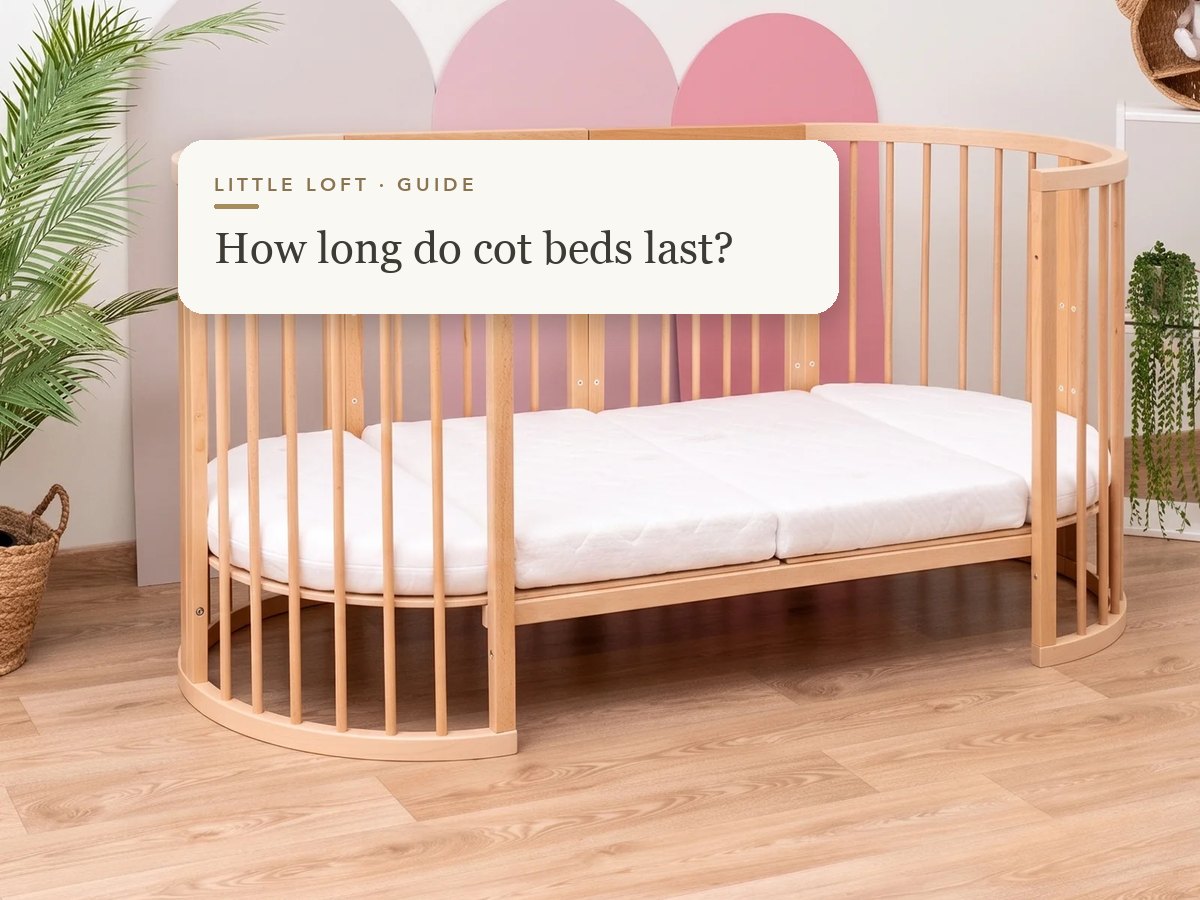
3. Multi-stage. A 5-in-1 or 7-in-1 changes its shape, size and job: round cot first, bigger cot next, playpen in between, table and chairs at the end.
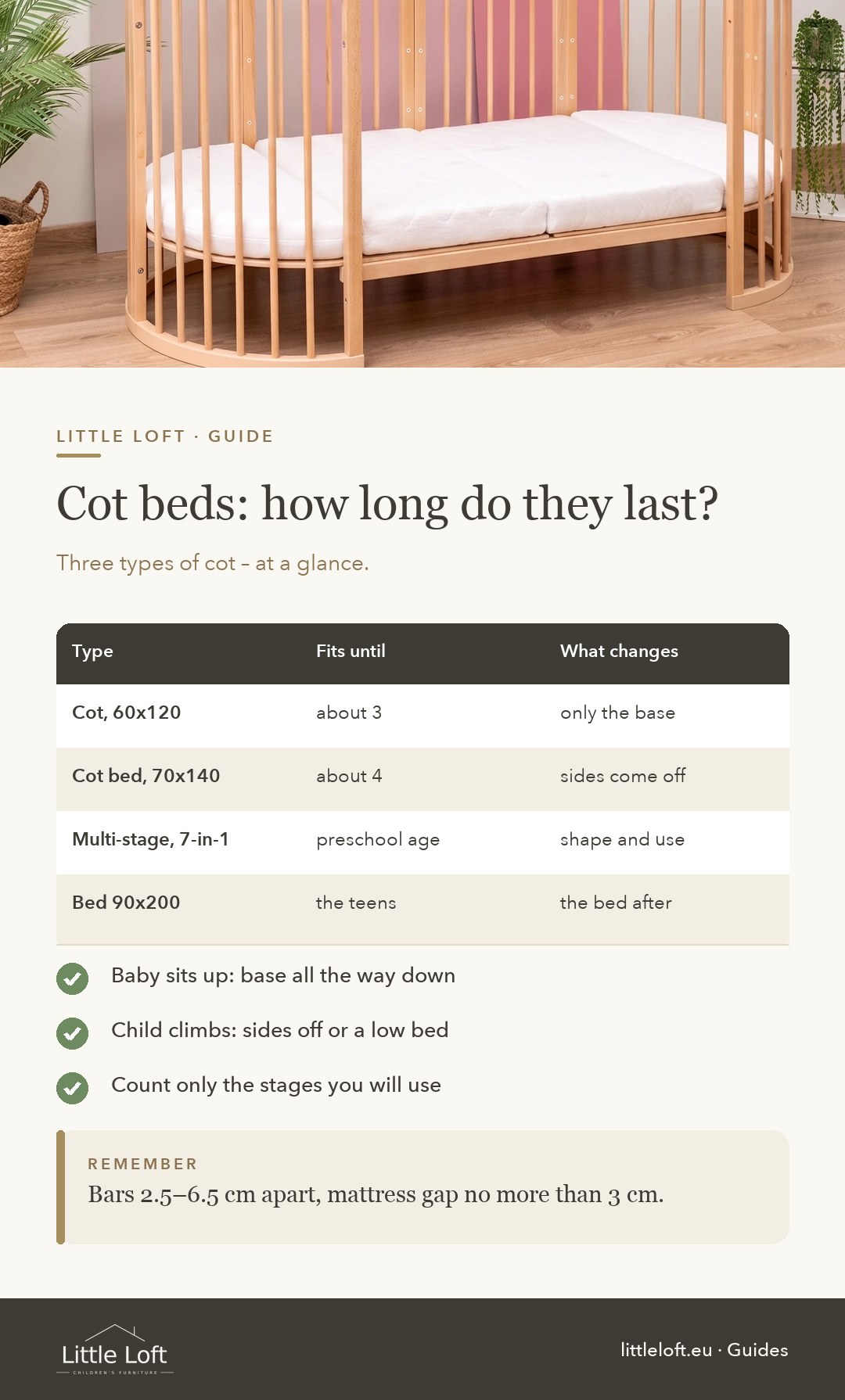
| Type | Fits until | What changes |
|---|---|---|
| Cot (60×120) | about 3 | only the base |
| Cot bed (70×140) | about 4 | sides come off |
| Multi-stage (7-in-1) | preschool age | shape and use |
| Bed 90×200 | the teens | not a cot |
The last row is part of an honest answer: no cot lasts until school. Which size comes next is covered in our chart of kids bed sizes by age.
Cot beds age limit: what decides it in real life?
The age printed on the box is the ceiling. Day to day, two things come first: how long the mattress is, and when your child starts climbing over the side.
Ireland’s health service puts it plainly in its book for parents: most young children stay in a cot until they are between 2 and 3 years old. It advises changing to a low bed, to prevent injuries, if your child learns to climb out of the cot or grows too big for it.
Put together with the usual advice on the base, the timeline looks like this:
- 0–6 months: base high. Many families use a Moses basket, a bedside crib or a small round cot in these months.
- from about 6 months: your baby sits up – base all the way down.
- 1½–3 years: your child tries to climb. They now need a way in and out, or a low bed.
- from about 3: the cot is getting short or tight. Time for the first big bed.
So a cot is really used for two to three years. Whatever a cot bed can do beyond that is a gain – as long as you use it.
What can a 7-in-1 cot do – and which stages matter?
Take our NOVA 7-in-1 cot, made of beech, as an example of a multi-stage design. The ages are the ones on the product page:
| Stage | Age | What for |
|---|---|---|
| Round cot | 0–6 months | small room, reach from all sides |
| Bedside cot | 0–36 months | right beside your bed |
| Bigger cot | 6–36 months | more room to sleep |
| Bed with a way in | from 3 years | in and out alone |
| Big child’s bed | from 3 years | with 4-part mattress |
| Playpen | daytime | playing, crawling |
| Table and chairs | afterwards | drawing, building |
The mattress can be set at four heights, and a 4-part mattress that suits every stage is included. A changing top comes with the round cot.
In practice the first three stages do most of the work: round cot, bedside cot and bigger cot take you through the first three years. The playpen earns its place if it stands in the living room by day. Table and chairs are a bonus, not a reason to buy.
Is a cot bed worth it?
Count pieces of furniture, not euro. List what you would otherwise buy in the early years:
- a Moses basket or bedside crib for the first months
- a 60×120 cot
- a playpen for the living room
- a small bed with a way in for the time after the cot
- a child’s table and chairs
Need three or more of them? Then a multi-stage cot replaces several purchases, and you buy one mattress instead of three.
It is less worth it if a bedside crib is already in the house, if you don’t want a playpen, or if your child will soon move to a big bed. A good, plain cot is then the calmer choice.
And it is only worth it when converting is simple. Three questions before you buy: are all the conversion parts included? Does one mattress fit every stage? Are there instructions for each stage?
Would a classic 60×120 cot do?
For many families, yes. 60×120 is the standard size, so sheets, sleeping bags and mattresses are easy to find, and the cot fits in the parents’ bedroom as well.
Our VERA cot in pine wood is exactly that: a slatted base with three heights, rounded bars and a 60×120 mattress included. The product page gives it as suitable until about 3 years. Optional rocker runners turn it into a cradle for the first months.
VERA grows in the simplest way – the base moves down, the sleeping area stays as it is. The upside: nothing to convert, no spare parts to store.
Cot bed vs cot: 60×120 or 70×140?
A 70×140 cot bed fits roughly a year longer. It is wider, though, and takes its own bedding size. If a 90×200 bed is coming next anyway, 60×120 will do.
What should you look for when buying?
The European standard for cots is EN 716. The points below hold for any cot, whatever the brand; the figures are those the consumer body Which? lists for cots and cot beds:
- Standard EN 716 named on the cot or in its instructions.
- Gap between the bars: no less than 2.5 cm and no more than 6.5 cm.
- Height-adjustable base.
- Sides high enough: at least 50 cm from the top of the mattress to the top of the side.
- A mattress that fits: a gap of no more than 3 cm. The HSE asks for a mattress that is firm, flat and fits the cot correctly.
- No cross-bars a child could use to climb up.
- Removable sides, or two bars that lift out.
With a cot that converts, three more points apply:
- Keep the parts and the instructions. A labelled bag tied to the slatted base is the easiest way.
- Tighten the screws after each conversion – and check them regularly from then on.
- Check the mattress at every stage. It must lie without a gap in every shape.
What comes after the cot bed?
Somewhere between two and four, the cot is done. From there you have two options.
For younger children who still need an enclosed place to sleep: the TEO Montessori bed in 90×190 has rails 55 cm high all the way round, and the way in is closed by a gate that parents open and close. Think of a cot at floor level – only far bigger. Read more in our guide to a floor bed for a 1 year old.
For children from about 2: a low bed in 90×200 with a bed rail. It fits into the teenage years – this is the bed that truly grows with a child. Many of our house beds in pine wood come in a floor-level Mini version, and legs can be added underneath later. Our guide to a bed for a 2 year old explains how to make the move.
Not sure which model suits? The Bed Advisor asks about age, room and wishes and suggests beds that match.
What are the most common mistakes?
- Buying by the number. “9-in-1” sounds like more than “3-in-1”. Count only the stages you will actually use.
- Lowering the base too late. Don’t wait for your child to stand. Once they sit, the base goes down.
- Losing the conversion parts. Two years in the attic, and the one screw you need is gone.
- The wrong mattress. Too small leaves a gap; too thick makes the sides lower.
- Staying in the cot too long. Once your child climbs over the side, the side no longer protects – it is the height of the fall.
- Forgetting the next bed. Even the best multi-stage cot is finished at preschool age. Plan the big bed in.
The bottom line: a cot bed lasts as long as you use its stages
A cot bed or multi-stage cot saves furniture and space when it suits the way you live: bedside cot at first, playpen in the living room, a bed with a way in later on. If none of that applies, a plain 60×120 cot is a sound choice.
In both cases the first big bed arrives between two and four. In the 3D configurator you pick the model, size, colour, bed rail and legs and view the bed from every side before you order.
Frequently asked questions about how long cot beds last
How long do cot beds last?
That depends on the type. A 60×120 cot with a height-adjustable base fits until about 3 years. A 70×140 cot bed with removable sides lasts around a year longer. A multi-stage cot such as a 7-in-1 goes up to preschool age. After that, every child needs a bigger bed, ideally in 90×200.
From what age can a baby sleep in a cot bed?
From the first night. For a newborn the base sits in its highest position, so you can lay your baby down without bending far. Multi-stage cots such as a 7-in-1 start as a small round cot or as a bedside cot next to the parents’ bed. Once your baby sits up unaided, move the base to its lowest position.
Is a cot bed worth it, especially a 7-in-1?
It is worth it when you really use several stages – for example the bedside cot, the bigger cot and the playpen. One piece of furniture then replaces three or more purchases, and one mattress fits all stages. If you only need a bed for the first two to three years, a plain 60×120 cot with an adjustable base will do.
Cot bed vs cot: is 60×120 or 70×140 better?
60×120 is the standard size: bedding and mattresses are easy to find, and the cot needs little space. A 70×140 cot bed fits roughly a year longer, but it is wider and takes its own bedding. If a child’s bed in 90×200 follows the cot anyway, 60×120 is enough for most families.
When should the cot base be lowered?
Once your baby can sit up unaided, the base belongs in its lowest position. Don’t wait until your child pulls up on the bars. Ireland’s HSE advises changing to a low bed if a child learns to climb out of the cot or grows too big for it.
What bed comes after a cot bed?
Most often a low child’s bed in 90×200 with a bed rail, from about 2 years. It fits into the teenage years. For younger children who still need an enclosed place to sleep, there are floor beds with rails all the way round and a gate that parents open and close.