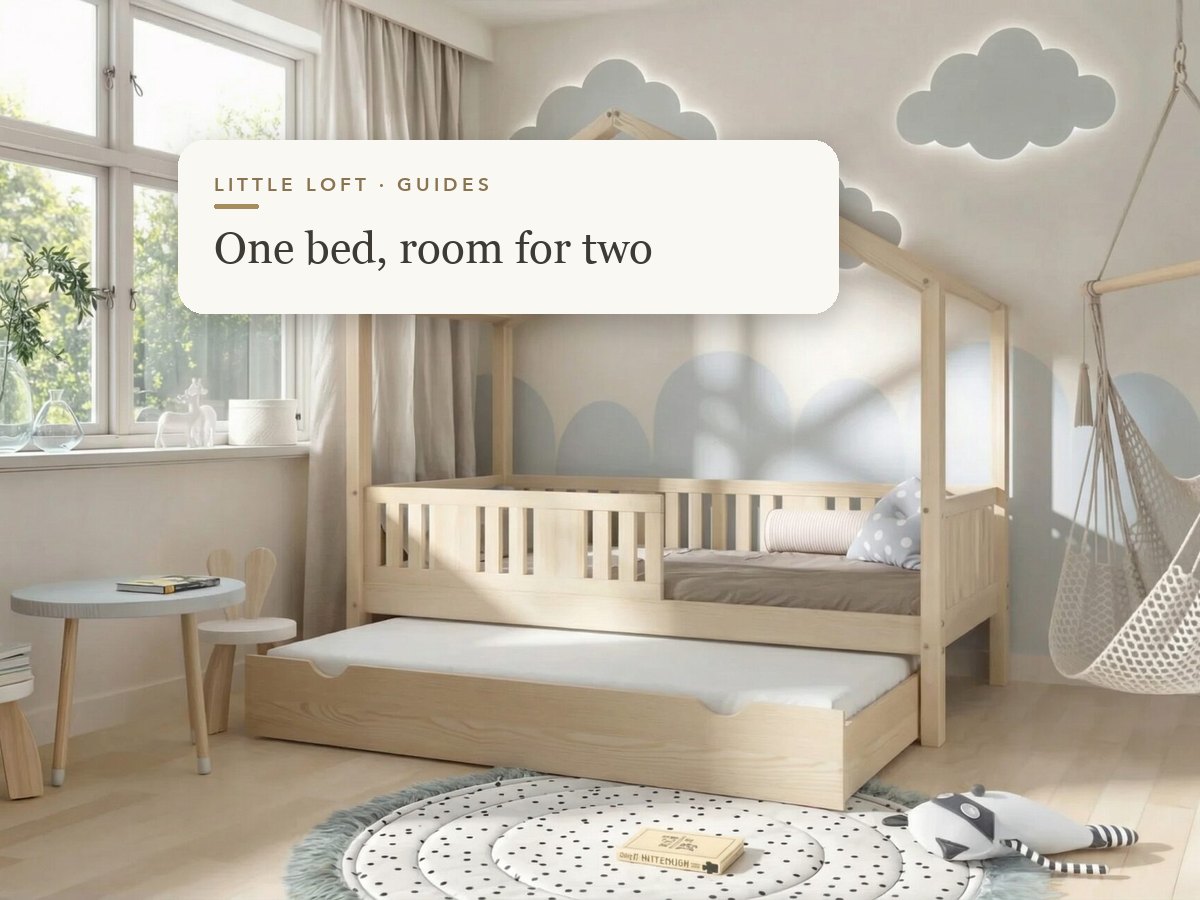
Trundle Bed for Kids: The Right Mattress, the Space You Need and From What Age
Trundle bed for kids: which mattress fits the pull-out drawer, how much floor you need in front of the bed and when a second bed is worth it.
A trundle bed for kids pays off when a second child stays the night every now and then – a brother or sister, a cousin, a friend from school – and the room has no space for a second bed. Whether it works comes down to three things: a mattress that fits the pull-out drawer exactly (on our beds 10 cm shorter than the bed and at most 10 cm high), enough free floor in front of the bed to pull it out, and a fall guard on the main bed.
In short
- A trundle is a drawer with a slatted base under the bed – by day, the second sleeping place is out of sight.
- On our beds the trundle mattress is 10 cm shorter than the bed: 90×190 for a 90×200 bed, and at most 10 cm high.
- In front of the bed you need free floor as wide as the bed itself, plus a narrow path to walk.
- Great for sleepovers and siblings from around 2 to 3 years – not a place for a baby to sleep.
- Not using it as a bed yet? The trundle makes a large storage drawer for bedding and toys.
Trundle, storage drawer or pop-up bed: what’s what?
Furniture shops across Europe use different words for things that look alike under the bed. A quick overview before you compare:
| Term | What it is | For sleeping? |
|---|---|---|
| Storage drawer | space under the bed, often on castors | no |
| Trundle drawer | drawer with a slatted base for a second mattress | yes |
| Pop-up trundle | lower bed that rises to the height of the main bed | yes, as one wide surface |
With our beds you simply choose the drawer with a sleeping function. Its base is a full slatted base, the same as in the main bed. Because the trundle sits just above the floor, falling from height is not a concern there.
Who is a trundle bed for kids a good idea for?
A trundle is at its best in these situations:
- Sleepovers: a friend stays over after a birthday party, the cousins visit in the school holidays. The guest bed is ready in two minutes – no air mattress on the floor.
- Siblings who want to be close: lots of children fall asleep more easily with a brother or sister right next to them. A trundle gives them that without two beds in the room.
- Unsettled weeks: after moving house, while a child is ill or going through a phase of bad dreams, having a sibling close by for a few nights often helps everyone sleep.
- Small children’s rooms: in a room of 8 to 10 m², there’s still space to play during the day, because the second bed rolls away under the first.
A trundle is less of a fit when two school-age children share a room every night. In that case a bunk bed or two separate beds is usually more comfortable (see the alternatives below).
Which mattress fits in a trundle drawer?
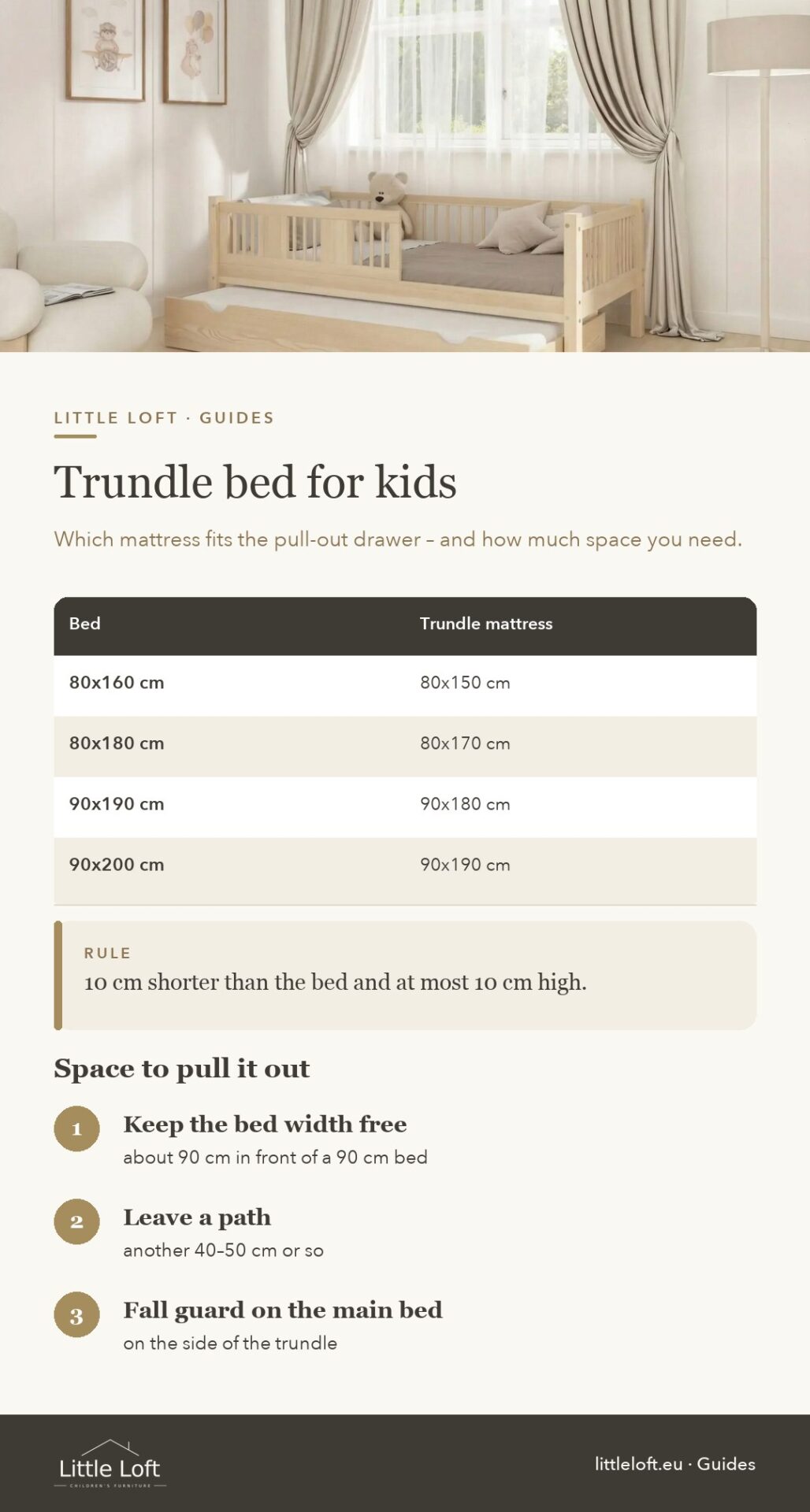
Parents ask us this more than anything else – and many shops only mention it in the small print. Our beds follow one simple rule: the trundle mattress is 10 cm shorter than the bed and at most 10 cm high. That keeps the drawer easy to slide under the bed, bedding included.
| Bed size | Trundle mattress | Max. height |
|---|---|---|
| 80×160 cm | 80×150 cm | 10 cm |
| 80×180 cm | 80×170 cm | 10 cm |
| 90×180 cm | 90×170 cm | 10 cm |
| 80×190 cm | 80×180 cm | 10 cm |
| 90×190 cm | 90×180 cm | 10 cm |
| 90×200 cm | 90×190 cm | 10 cm |
Keep in mind:
- The main bed’s mattress won’t fit. In most of Europe 90×200 is the standard single size, and a 90×200 mattress is too long – and usually too high – for the trundle of a 90×200 bed.
- Firm rather than soft: in the trundle, too, your child needs a firm, supportive children’s mattress. A soft folding foam mattress is fine for a single night, but not for regular sleep.
- Watch the height: many children’s mattresses are 12 to 16 cm high. For the trundle, our product pages recommend the COCCOPURE Children’s Mattress and the OPTIMA Children’s Mattress, as both stay within the 10 cm limit.
You can see all sizes in our children’s mattresses category. For any other bed size, the matching trundle mattress is shown on the product page.
How much room does a trundle bed need?
By day, a bed with a trundle needs no more space than an ordinary single bed. At night a second sleeping surface appears in front of it, so plan the room like this:
- Take the bed width as your guide: once pulled out, the trundle needs roughly as much free floor in front of the bed as the bed is wide – about 90 cm for a 90 cm bed.
- Leave a path: so no one has to step over the guest bed at night, keep another 40 to 50 cm free, for example towards the door.
- Clear the way: a thick rug, a chest of drawers or a toy box must not block the drawer. The trundle runs on castors, so it needs a level floor – wooden, laminate or tiled floors are ideal.
- Only on beds with legs: the trundle needs space under the bed. That’s why our beds with a drawer stand on 20 cm legs; the Mini versions that sit on the floor have no drawer.
Before you buy, measure the room and mark the area on the floor with painter’s tape – you’ll see at once whether the door and the wardrobe can still open.
Every night or just for guests: how comfortable is a trundle?
For guests and the occasional sleepover, a trundle is perfect. A child can also sleep in it every night – it just takes a few habits:
- Let it breathe: in the morning, leave the drawer pulled out for a while so the mattress can air before you push it back. The slatted base helps air reach the mattress.
- Store the bedding inside: a light pillow and a thin duvet fit in the drawer, so the bed is made in seconds in the evening.
- Give it a sense of ownership: with siblings, it helps when the lower bed has its own bedding and a fixed place for the favourite cuddly toy. Then the younger one doesn’t feel like a visitor in their own room.
An honest note: a 10 cm mattress is a little thinner than the main mattress. That’s perfectly fine for children up to primary school age; for teenagers it’s better for the odd night.
From what age can a child sleep in a trundle bed?
The trundle is close to the floor and has no fall guard of its own. It’s therefore suitable for children who already sleep in a regular bed – usually from about 2 to 3 years. A trundle drawer is not a sleeping place for babies; they belong in their own cot with a firm, flat mattress.
The trundle follows the same rules as any children’s bed: a firm mattress that fits the drawer exactly, no gaps at the sides and no thick pillow for small children. Ireland’s HSE explains where toddlers typically fall at home – bunk beds included – and how to prevent it (HSE: preventing falls in toddlers and children).
Something many parents miss: the child in the main bed. With the trundle pulled out at night, the sibling lies directly in front of the main bed. So put the fall guard on the main bed on the trundle side. On our house beds it can go on the left or the right, and you can remove it later.
Trundle or bunk bed? Other options for two children
A trundle is not always the right answer. This helps you decide:
- Bunk bed: if two children share a room every night, bunk beds save just as much floor space – and each child sleeps on a full-size mattress. Under EN 747, the upper bed is only suitable from 6 years.
- Two separate beds: in a larger room, or for children with very different bedtimes, this is often the most peaceful solution.
- One wider bed on the floor: if it’s mostly you lying down with your child to fall asleep, a wider bed suits you better. More in our guide Floor Bed 140×200 for Kids: Who the Wide Bed Is Really For.
- Drawer for storage only: if you don’t need a second bed yet, go for the large drawer or two small drawers for bedding, toys and clothes.
Which Little Loft beds have a trundle?
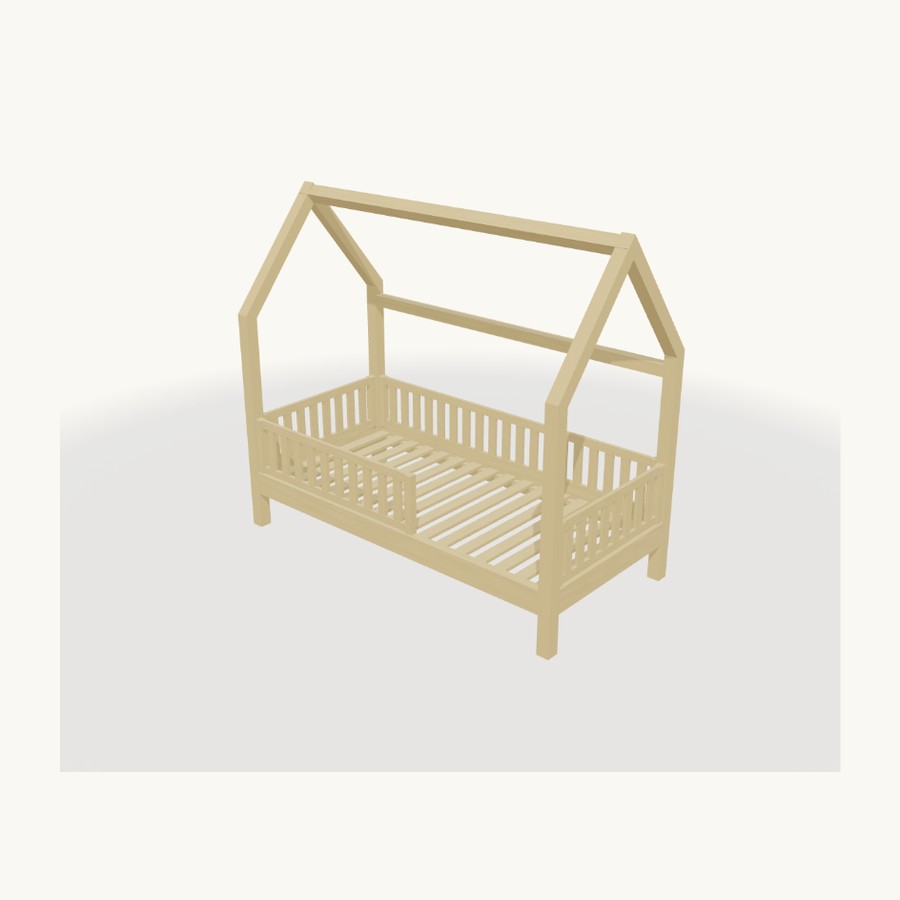
At Little Loft every bed “with drawer” can be ordered with the sleeping function – for example the LUNETTA Children’s Bed with Drawer, the ASTRIA Children’s Bed with Drawer or the SOLETTA Children’s Bed with Drawer. Prefer a bed without a roof? The LUNA Children’s Bed with Drawer is a simple design with fall guards.
All our beds are made from pine wood (FSC), handmade in Europe and finished with a water-based lacquer. Over 3,200 families already sleep in them, and we give a 5-year guarantee on the bed frame – including the drawer, slatted base and fittings.
Conclusion: a trundle bed for kids works when the mattress is right
A trundle bed for kids adds a second sleeping place without taking space from the room. To make it comfortable, choose a mattress 10 cm shorter than the bed and at most 10 cm high, keep roughly one bed width plus a path free in front of the bed, and put the fall guard on the trundle side. If two children will share every night for years, compare it with a bunk bed too.
Still unsure which model is right? Our Bed Advisor narrows it down in a few questions – or choose size, colour, drawer and fall guard yourself in the 3D configurator and view the bed from every angle.
Frequently asked questions about a trundle bed for kids
Which mattress do I need for a trundle drawer?
On our beds, the trundle mattress is 10 cm shorter than the bed and at most 10 cm high. A 90×200 bed, the most common size in Europe, therefore takes a 90×190 mattress in the trundle. Choose a firm children’s mattress that fits the drawer without gaps. The right size is shown on every product page.
Can my child sleep in the trundle every night?
Yes, if the mattress is firm and fits exactly. Leave the drawer pulled out for a while each morning so the mattress can air. A 10 cm mattress works well for children up to primary school age. If two older children will share a room every night for years, a bunk bed is usually the more comfortable choice.
How much floor space does a trundle bed need?
By day, no more than a normal single bed. At night you need roughly as much free floor in front of the bed as the bed is wide – about 90 cm for a 90 cm bed – plus a 40 to 50 cm path. The floor should be level, because the trundle rolls on castors.
Low trundle or pop-up trundle: which is better?
A low trundle sits just above the floor, so a fall is hardly possible, and by day it vanishes completely under the bed. A pop-up trundle rises to the height of the main bed and creates one wide sleeping surface, but it needs its own mechanism. In a children’s room, the low trundle is usually the easier option.
From what age can a child sleep in a trundle bed?
As soon as they sleep in a regular children’s bed, usually from about 2 to 3 years. The trundle has no fall guard of its own, but it is close to the floor. It is not a sleeping place for babies, who belong in a cot. Put the fall guard on the main bed on the side where the trundle pulls out.
Can I use the trundle drawer for storage instead?
Yes. On our beds with a drawer you can choose one large drawer, two small drawers or the drawer with a sleeping function. Even the trundle can be used without a mattress to store bedding or toys whenever nobody is staying over, so the space under the bed is always put to good use.