Floor Bed for 1 Year Old: Cot, Floor Bed or Mini House Bed?
Floor bed for a 1 year old or cot? When the cot is still fine, when a floor bed is safer, and how to make your toddler's room childproof.
At one year old, most children still sleep well and safely in their cot, with the base on its lowest setting. A floor bed for a 1 year old, with a low fall guard instead of tall bars, makes sense once your child walks confidently, climbs over the cot rail or really wants to get in and out on their own. A mini house bed directly on the floor is usually the next step around the second birthday.
In short
- At 12 to 18 months, a cot on its lowest base setting is usually still the simplest and safest choice.
- If your child climbs over the cot rail, a bed on the floor is safer than a tall cot – that is the moment to switch.
- A floor bed for a 1 year old needs a fall guard and a childproof room, because your child can now get up at night.
- A firm, flat mattress, no pillow and a sleeping bag instead of a duvet still apply in the new bed.
- 90×190 or 90×200 suits most families, so the bed lasts for many years.
Cot, floor bed or mini house bed: what suits a child of 12 to 18 months?
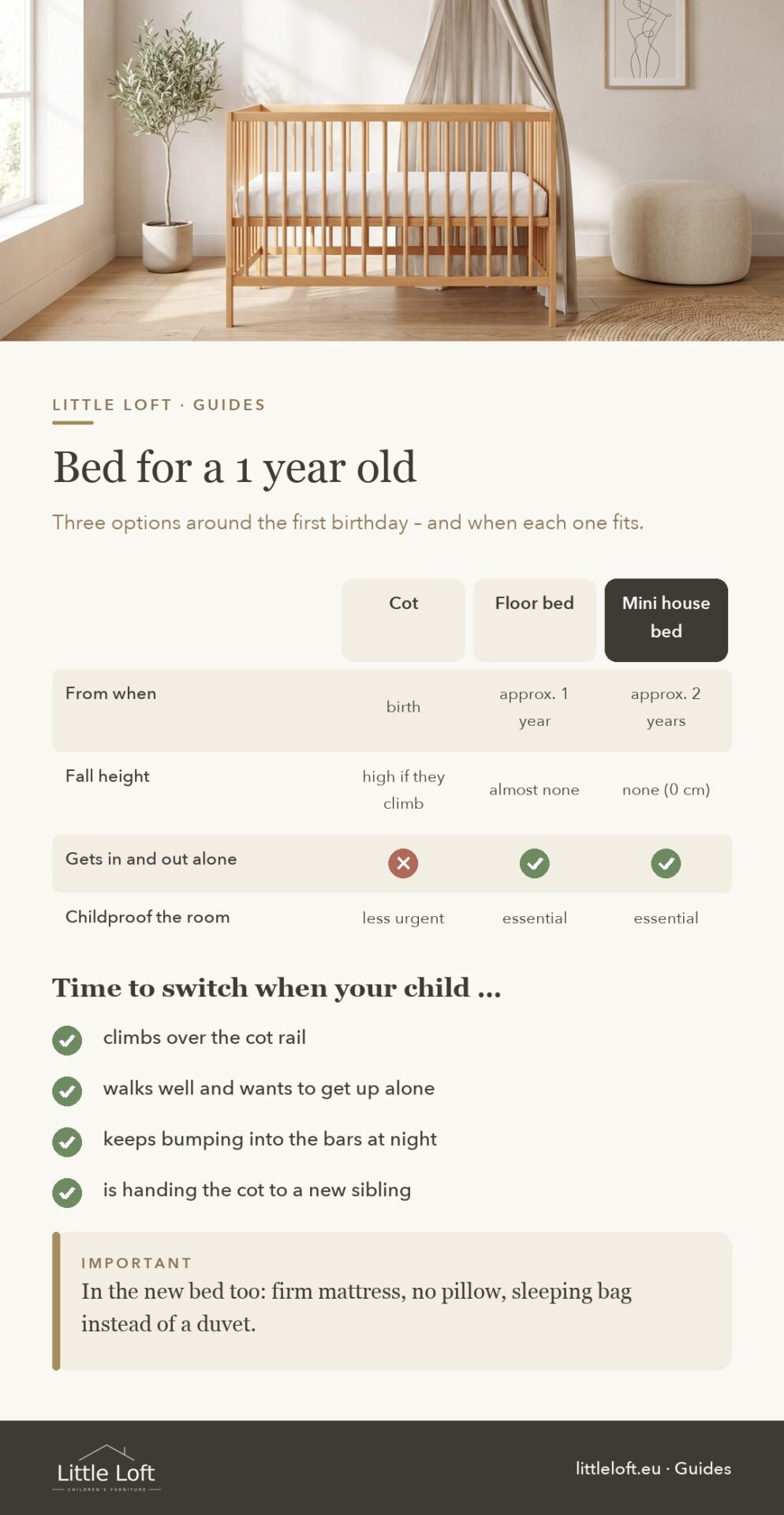
Around the first birthday there are three realistic options. None of them is right for every child. What matters is not the number of candles on the cake, but what your child can already do and how they sleep.
| Option | Suits your child if … | Keep in mind |
|---|---|---|
| Cot on the lowest setting | they sleep well and don’t climb | becomes risky once they climb over |
| Floor bed with fall guard | they walk well and want to get up alone | the room must be childproof |
| Mini house bed on the floor | they are about 2 years old | we recommend it from about 2 |
Many parents start asking the question because the cot suddenly seems “too small”. Often it isn’t really about size, though, but about a child who wants more freedom. The signs in the next section help you tell the difference.
How do you know your child has outgrown the cot?
A move makes sense if one of these signs applies:
- Your child climbs over the rail or puts a foot on the top edge. This is the most important signal: a fall over the cot rail is more dangerous than a tumble out of a bed on the floor.
- They stand up in the cot and call for you because they can’t get out, and then find it harder to settle again.
- They keep bumping into the bars at night or lie across the mattress, because a 60×120 cm cot is getting cramped.
- A new baby is on the way and needs the cot. Plan the move a few weeks before the birth, so your toddler doesn’t feel pushed out.
If none of these apply, there is no reason to rush. Plenty of children sleep happily in their cot until their second or even third birthday.
Option 1: Lower the cot base – when that is still enough
Most cots have a height-adjustable base. As soon as your child pulls up to standing, it belongs on the lowest setting, so the top of the rail is as high above the mattress as possible. On our VERA cot bed, the lowest of the three heights is designed exactly for babies who are starting to sit and stand.
A cot with removable bars is a good in-between step: you open one side and your child can climb in and out during the day. The convertible NOVA 7-in-1 cot bed in beech wood, for example, later becomes a bed with a side opening and then a full-size children’s bed.
Stay with the cot if your child sleeps well, doesn’t climb and you aren’t ready to childproof the whole room yet. You’re not doing anything wrong.
Option 2: A floor bed for a 1 year old – what needs to be in place?
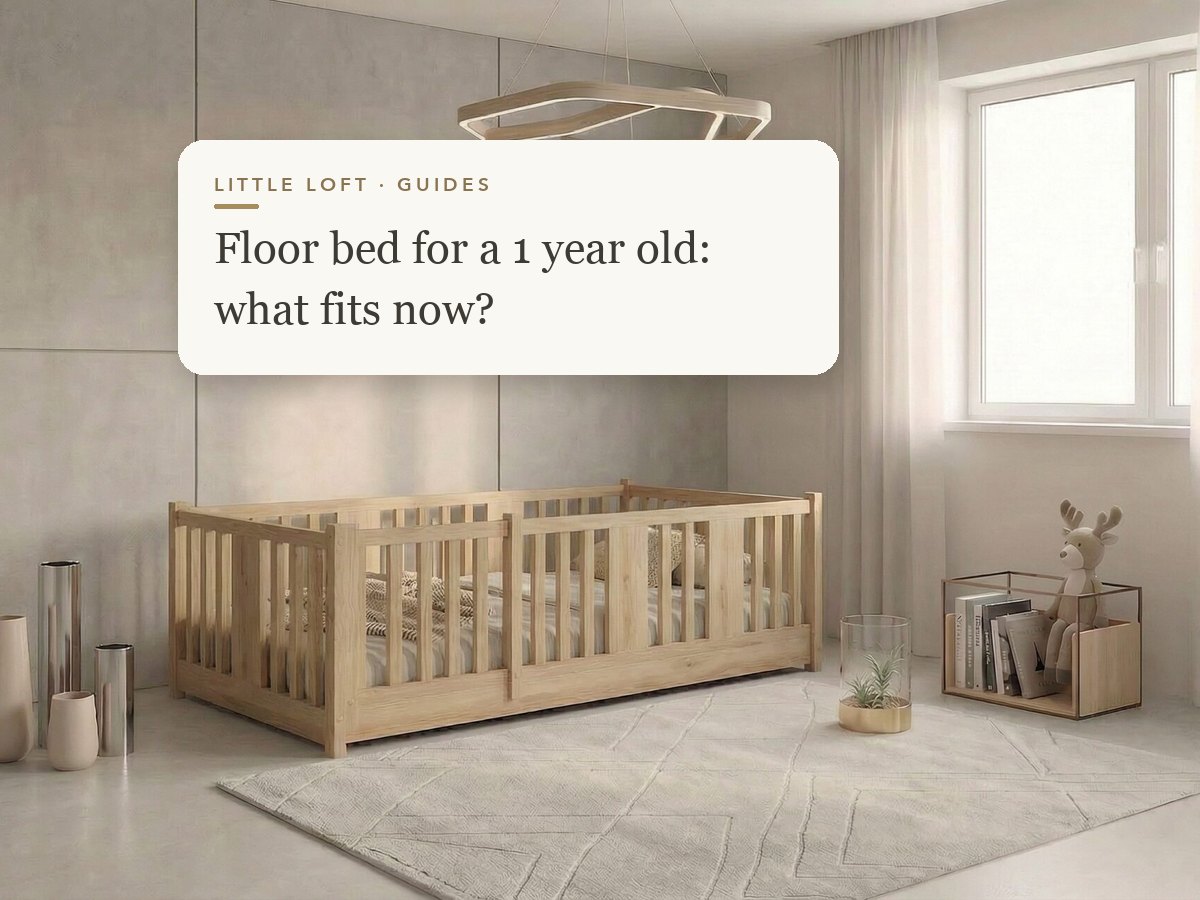
A floor bed (often called a Montessori bed) stands directly or almost directly on the floor. Your child can get in and out alone and learns early on that their bed is their own place. For this to work at one year old, these conditions should be met:
- Your child walks confidently or crawls out of bed backwards on purpose.
- The bed has a fall guard along the sides, with an opening for getting in and out.
- The sleeping surface is firm: a firm children’s mattress, no pillow, no thick sheepskins.
- The whole room is childproof, because your child can now get up alone at night (see the checklist below).
Our Montessori beds TEO and MILO are built for exactly this: a 90×190 cm sleeping area, only 1–2 cm floor clearance, 55 cm high safety barriers with 5 cm between the slats, and one open side for climbing in. MILO has round slats.
Expect your child to get up at night and play in their room during the first few weeks. That is normal and usually settles after a while. A steady bedtime routine helps more than a new bed on its own.
Option 3: A mini house bed – the step around the second birthday
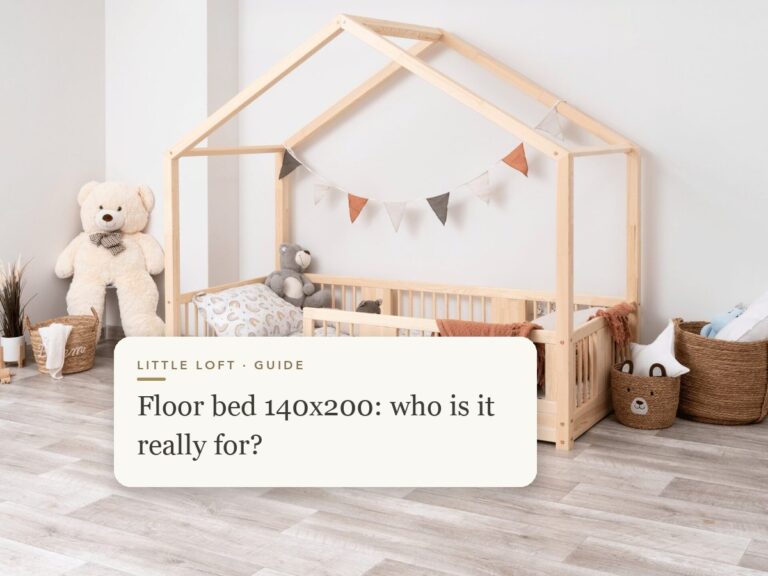
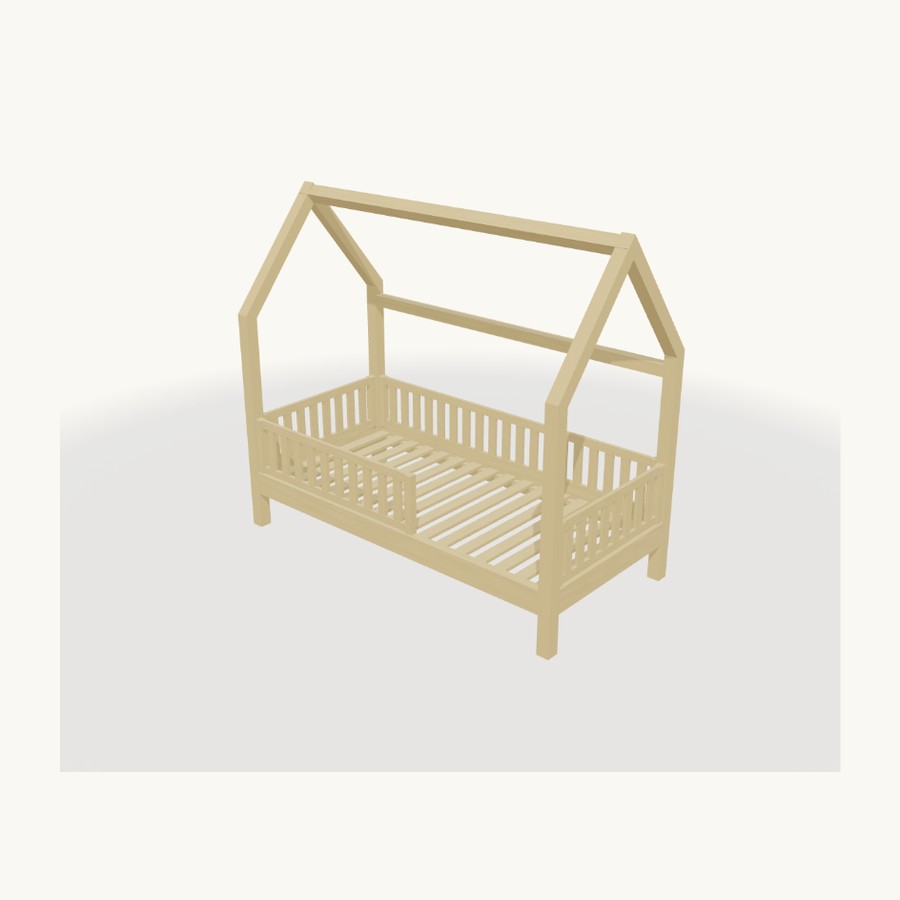
A mini house bed stands directly on the floor like a floor bed (0 cm height), but it has a wooden roof frame and a fall guard that you fit on the left or right and can take off later. For many children, the bed becomes a little den they actually look forward to.
We recommend our Mini beds, such as the LUNA Mini children’s bed or the LUMINA Mini, as a first bed for children aged roughly 2 to 5. For a one-year-old, a floor bed with barriers on several sides is often the better choice. If you’d like to buy the house bed now, pay particular attention to the fall guard and to a childproof room. The slatted base of the Mini beds carries up to 190 kg, so you can lie down next to your child at bedtime.
You’ll find more models in our house beds range. If you’d like to combine size, colour and fall guard yourself, you can view your bed from every side in the 3D configurator.
Which size for a 1 year old: 70×140 or straight to 90×200?
A 70×140 toddler bed is smaller and takes up less space, but it is often too short by the age of four or five. Then you buy a second bed. With 90×190 or 90×200, on the other hand, you have a bed that lasts into the school years and beyond.
- 90×200 is the standard size for mattresses and bedding in continental Europe, and the most popular size with our families.
- 90×190 fits well in smaller rooms – our Montessori beds TEO and MILO have this sleeping area.
- 140×200 is worth it if you regularly lie down with your child at bedtime. More on this in our guide floor bed 140×200 for kids.
For a one-year-old, the mattress matters more than the width: firm and supportive rather than soft. It should fit the frame exactly, without gaps at the sides.
Checklist: how to make your 1 year old’s room safe
As soon as your child can get out of bed alone at night, the whole room becomes part of the sleeping space. It helps to go round the room once on your knees – at your child’s eye level:
- Fit socket covers; keep cables and blind cords out of reach.
- Fix chests of drawers, shelves and wardrobes to the wall so nothing can tip over.
- Secure windows with locks or restrictors, and don’t place the bed directly under a window.
- No small parts, coins or button batteries on the floor or within reach.
- Use a safety gate on the stairs or the bedroom door if your child shouldn’t wander around at night.
- Keep the room comfortably cool, around 16–20 °C, with a sleeping bag instead of a duvet.
- A soft rug in front of the bed for the first nights.
For the sleeping space itself, the familiar rules still apply. The Lullaby Trust’s safer sleep advice recommends a firm, flat mattress and a clear sleep space without pillows or bulky bedding (The Lullaby Trust: safer sleep advice). If you have questions about your child’s sleep, your public health nurse or GP is a good first contact.
Floor bed for a 1 year old: switch now or wait?
If your child sleeps well and doesn’t climb, there’s no hurry: keep the cot on its lowest setting. If they climb over the rail or are determined to get into bed by themselves, a floor bed with a fall guard in a childproof room is the safer choice. A mini house bed is a lovely next step around the second birthday.
Not sure which model suits your child? Our Bed Advisor guides you to the right bed in a few questions – or design it yourself in the 3D configurator.
Floor bed for a 1 year old: frequently asked questions
Can a 1 year old sleep in a bed without cot bars?
Yes, if the bed is low and has a fall guard. A floor bed with barriers and one open side suits many one-year-olds who walk confidently. The key is a childproof room, because your child can now get up alone at night. If they sleep well in the cot and don’t climb, you can also simply wait.
Is a floor bed safe for a 1 year old?
A floor bed has almost no fall height, so it is safer than a cot that a child is climbing out of. It becomes safe with a firm mattress, a fall guard along the sides, no pillow, and a room in which sockets, windows and furniture are secured. Check the room again whenever your child learns something new.
Sleeping bag or duvet for a 1 year old?
A sleeping bag is the safer choice, because your child can’t wriggle under it or kick it off. Safer sleep guidance recommends keeping the sleep space clear of bulky bedding. Many families stay with a sleeping bag until around the second birthday or longer, and only then move to a light toddler duvet.
Which mattress suits a 1 year old?
A firm, supportive children’s mattress that fits the frame exactly, with no gap at the sides. Soft mattresses or adult mattresses give too much under a light body. Your child doesn’t need a pillow at this age. A breathable cover and a slatted base underneath help keep the mattress dry and fresh.
What if my child keeps climbing out of the floor bed at night?
Take them back to bed calmly and with few words. This is normal in the first few weeks and usually settles. A steady bedtime routine, a darkened room and a soft rug in front of the bed all help. Most importantly, make sure the whole room is childproof, because your child will explore it.
How long can my child use the new bed?
That depends on the size. A 70×140 bed is often too short by the age of four or five. A floor bed in 90×190 or a mini house bed in 90×200 will see your child through to school age and beyond. The fall guard can be taken off later, so the bed grows with your child.